Saturday, February 23, 2013


FIFTY YEARS AGO (1963 - 2013):
The Council -- Two Conclaves --
Continuity and Reform
(Part One of five...)
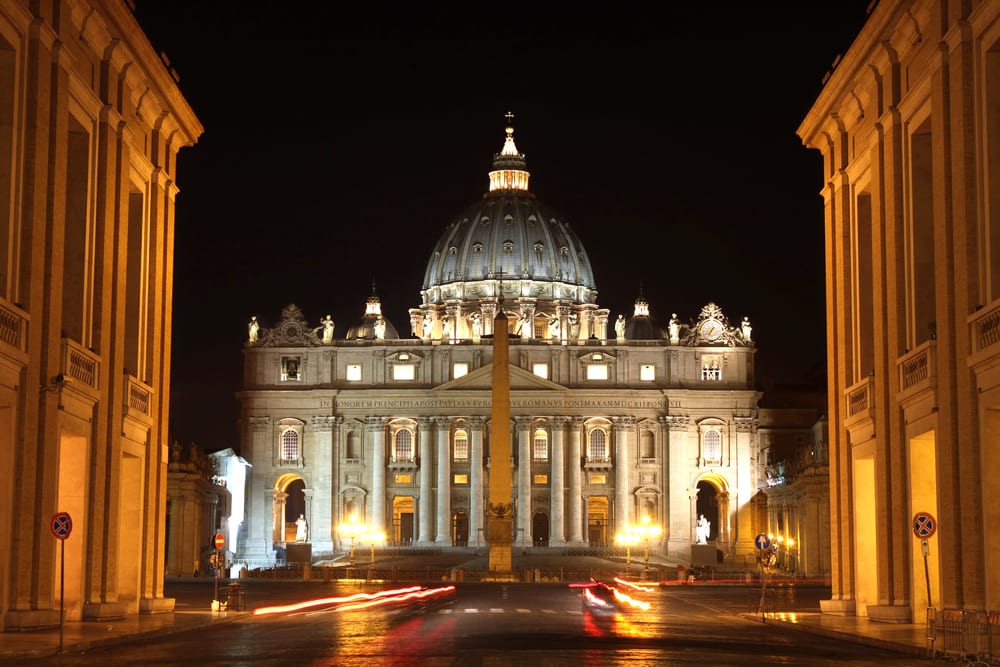

I sit at a desk in Vatican City, in the residence where in just a few days, Cardinals from throughout the world will come to bid farewell to Pope Benedict XVI and prepare to be electors in the March conclave to elect a new Pope.

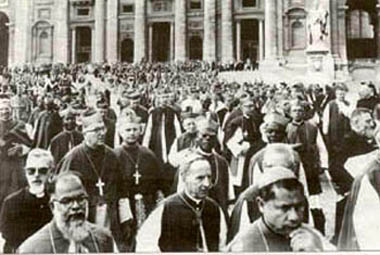
It was fifty years ago, in 1963, that other Cardinals gathered in the Vatican -- but not in the comfort of this Domus Sanctae Marthae -- for the conclave after the death of Pope John XXIII. 
+ + + + +


They were both old men when they had been elected Pope, replacing men who had been “great” Popes for two decades or more…
Once elected, both had brief, but very busy, challenging papacies…
And both left a lot of finished business.
+ + + + +
The Papal conclave in the Sistine Chapel after the death of the 81-year old Pope John XXIII took place in 1963.  The conclave after the resignation of Pope Benedict XVI at age 85 will take place exactly half-a-century later, in 2013.  The word “continuity was of prime importance 50 years ago: Would the Council continue?   
And today, no doubt the word continuity” will be for the gathered Cardinals an important matter of discussion – and likewise an important consideration in the choosing – of a new Pope in 2013.

 The pressing question of that time 50 years ago was whether the new Pope would call a halt to the Second Vatican Council -- or continue it. Under Pope Paul VI (Cardinal Giovani Battista Montini), chosen by the Cardinals at the 1963 conclave, plans for the 2nd session of the Vatican Council continued.
 
     That word continue has become, five decades later, a key term in the Pontificate of Benedict XVI.  On the day the Pope announced his resignation, the Dean of the College of Cardinals, Angelo Sodano, replied to the Pope in the name of all the members of the Sacred College:

       "You began your luminous pontificate following in continuity -- that continuity you have spoken to us so much ... In continuity with your 265 predecessors in the chair of Peter."

 " ... That continuity you have spoken to us so much ..."

     There are many more historical similarities between the conclave of 1963 and the upcoming conclave of 2013.
     And, along with continuity, in the last few days the volume has increased in a serious call for reform.
Next:
Similarities 1963 and 2013
JTM


Wednesday, January 30, 2013

WORK BETWEEN THE FIRST
AND SECOND SESSIONS 

In early 1963, during months after the first session of the Council, a special commission reviewed the schemata (documents) which had been discussed by the world's Bishops from October to December 1962, 

 Pope John XXIII - through the Council Secrtariat - set down six norms for the interim work:

-- "It is necessary during the long interval to provide for a reexamination and a perfecting of the projects, taking into due account the work almready done."  Special subcommissions on each topic would be of assistance.

--  "The salient point of this Council is not the discussion of one article or other of the fundamental doctrine of the Church ... The substance of our ancient doctrine is one thing, the way in which it is presented is another."  The stress would be on the pastoral nature of the Council.

-- The interim work would deal with general principles, "leaving aside particular problems".

-- A new central committee had been created to "direct and coordinate the work of the Council... whichshould be carried out in agreement with the presidents of the Council commissioms."  Periti (experts) would help the commissions.

-- As soon as working papers were prepared, they should be sent to the world's Bishops -- who, in turn, are to "examine them and return them within a time limit to be set by the General Secretariat."

-- "The Council commissions, after receiving the observations of the Bishops, will see to the amendments... taking into account the suggestions and cloely assessing the reasons for and against, so that they may , at the end of an adequate re-elaboration, be submitted to the Council Fathers" during Session II.

Monday, December 24, 2012


THIS WEEK AT VATICAN II
DECEMBER 1962 - 50 Years Later


Pope John XXIII Named
Time 's "Man of the Year"


The opening words of the U.S. newsweekly's announcement:

The Year of Our Lord 1962 was a year of American resolve, Russian orbiting, European union and Chinese war.
In a tense yet hope-filled time, these were the events that dominated conversation and invited history's scrutiny. But history has a long eye, and it is quite possible that in her vision 1962's most fateful rendezvous took place in the world's most famous church—having lived for years in men's hearts and minds.
That event was the beginning of a revolution in Christianity, the ancient faith whose 900 million adherents make it the world's largest religion...

Thursday, December 6, 2012


THIS WEEK AT VATICAN II --
50 Years Later
December 1962


THE END OF THE FIRST SESSION


What was accomplished?


             At the end of the first session on December 8, Pope John XXIII said that “the first session was like a slow, solemn introduction to the great work of the Council … It was necessary for brothers, gathered from afar, to make each other’s closer acquaintance; it was necessary for them to look at each other squarely in order to understand each other’s hearts; and to describe their own experiences … under the most varied climates and circumstances, so that there could be a thoughtful interchange of views on pastoral matters.”

             The U.S. Bishops’ own Council Daybook  recalled this “human side of Council” – “Around 11 o’clock each morning, scenes develop in the side aisles of the basilica which - except for the purple robes and colored marbles - could be seen in the corridors and cloakrooms of the U.S. Senate…Clusters of Bishops engage in animated conversation, form, dissolve, reform with new members…in cloakroom and coffee lounge.” 

               During the first session, the 2,500 Bishops got to know one another, realizing the vastness and the vitality of Christ’s  Church throughout the world.


 What wasn’t accomplished?   

          None of the conciliar documents was ready for promulgation at the end of the first session. The Bishops decided that the schemata which had been prepared before the Council – for the most part by curial officials – did not reflect the pastoral style of the Council.

          One conciliar historian noted that:  “The German theologian Father Josef Ratzinger called the absence of any approved Council text before the end of the first session “the great, astonishing,  genuinely positive result of the first session.”  The fact that no text had gained approval was evidence, he said, of “the strong reaction against the spirit of the preparatory work.”  This he called “the truly epoch-making character of the Council’s  first session."


What were the plans for the second session?

       Pope John expected to call the Bishops back to Rome in early 1963.  There was need for more discussion on the Sacred Liturgy, the Sources of Revelation, the Role of Bishops, and the very nature of the Church itself.  If re-writing (in some cases),  amendments (to several decrees), and preparations for topics not yet addressed could go forward at a rapid pace, the Ecumenical Council might end at Christmas 1963, which would be precisely four hundred years after the Council of Trent.


        That schedule was to be changed, because of the sheer magnitude of the work to be done – and because of Pope John’s failing health.  After the first session, the Bishops returned to their dioceses “changed men”;  when they returned to Rome,  they would find dramatic changes, including a new Pope – who would commit himself to the ongoing work of the Second Vatican Council.    

                                                                                                  (Coming Next:  June 1963 – The Death of Pope John, the Election of Pope Paul)

- Monsignor John T. Myler

Sunday, November 25, 2012


This Week at Vatican II  
          – Fifty Years Later

             December 1962


OBSERVERS AND GUESTS AT THE COUNCIL

 
               In the 19th century, during the months leading up to the First Vatican Council, Blessed Pope Pius IX wrote to all the Patriarchs of the Orthodox Church; they were informed that, if they “ended their separation” from the Roman Catholic Church, they would be welcomed at Vatican I – as full, validly ordained and consecrated Bishops.  During the same days in 1868, Pius IX issued a call to Protestant leaders and their people “to return to the Catholic Church,” ending their visible separation from Catholic unity.   Both the Orthodox and the Protestants were offended by the wording of the appeals. Neither group participated in the First Vatican Council.

 
               Nearly a century later, before Vatican II convened, Blessed Pope John XXIII –  with talents he had honed from years in diplomacy --- invited Orthodox and Protestant “observers” to the Council.  He joyfully welcomed them to the First Session -- the first time a Pope had ever met collectively with a group with non-Catholic representatives, including:

 
(Among the Orthodox:)

Patriarchate of Moscow

Coptic Patriarchate of Alexandria 
 
Syrian Patriarchate of Antioch      

Ethiopian Church                             

Armenian Catholicate of Cilicia     

Russian Church in exile                   

(Among the Protestants:)

Anglican Union

Lutheran Federation

Presbyterian Alliance

German Evangelical Church

Disciples of Christ       

World Methodist Council
 

            Pope John had appointed the German Jesuit, Augustine Cardinal Bea, to be president of a new “Secretariat for Promoting Christian Unity.”  Cardinal Bea, although seventy-nine years old, was a professor and Biblical scholar – and the “Biblical Movement” of the 20th century had often been a “meeting point” for Catholics and Protestants. Cardinal Bea welcomed the observers  with the words: “Instead of a long listing of your titles, which I certainly do respect, please allow me to address you with these simple but so profound words:
 

            ‘My Brothers in Christ.’”
         

            In a moving response, Dr. Edmund Schlink, a Lutheran professor from Heidelburg University, said that Pope John “by the initiative of his heart has created a new atmosphere of openness in regard to the non-Roman churches.”
        

            After six weeks, the distinguished professor Oscar Cullmann of the Universities of Basel and Paris explained to the press that the invited Observers had received all the Council texts, attended all General Congregations, could make their views known at weekly meetings of the Secretariat, and had personal contact with the Bishops and their periti --  “daily reveal(ing) to us how truly we are drawn closer together.”


            However, in “The Rhine flows into the Tiber”, historian R. M. Wiltgen recalls: “Professor Cullman also pointed out that mistaken conclusions were being drawn from the presence of the Observers … among both Catholics and Protestants who appeared to think that the purpose of the Council was to bring about union between the Catholic and other Christian churches.  That was not the immediate purpose of the Council, he said, and he feared that many such people would be disillusioned when, after the end of the Council, they found that the Churches remained distinct.”
 
 
Next Week: The End of the First Session
 
- Monsignor John T. Myler


THIS WEEK AT VATICAN II
              -- Fifty Years Later 

               November 1962
           

Prophetic About Social Communications


                 Inter mirificaAmong the wonderful technological discoveries which men of talent, especially in the present era, have made with God's help, the Church welcomes and promotes with special interest those …which have uncovered new avenues of communicating most readily news, views and teachings of every sort.”

               During the first session of Vatican II – in late November, 1962 -- the Council Fathers began discussion of the schema on the modern means of social communications.  Over three days, more than 50 Council Fathers made interventions about the text prepared by the “Commission on the Apostolate of the Laity, the Press and Information Media.”  Additionally, proposals on the entertainment media had been drawn up by Archbishop Martin J. O’Connor, the rector of the North American College in Rome, who had served since the late 1940’s as president of the Pontifical Commission for Radio, Television and Motion Pictures.

               No previous Council had discussed such a topic.  Each Bishop received a copy of the proposed document, which consisted of four parts:
--- The Church’s doctrine on the subject
 
--- The media as a help to the apostolate
 

--- Disciplinary norms of the Church
 

--- Each of the major media: the press / cinema / radio and television

 
In their discussion, the Bishops spoke very favorably of the schema and the importance of the Church’s use, cooperation with – and, in some cases – regulation of the modern means of social communications.


               The Council Fathers agreed that these media could be of help in transmitting the Gospel message to all parts of the world;  ecumenical and inter-religious messages of peace, justice and human dignity could also be universally spread.  Nevertheless, the Church had a responsibility to see that “such a vast force will not be abandoned to evil.” 


               Among the suggestions was the institution of an office in the Vatican – or an expansion of Archbishop O’Connor’s  commission – which would “have the task of creating an official organization on an international, national, and diocesan basis for the communications media and for the purpose of forming and informing the public opinion.”


                Trained members of the Catholic laity had expertise in these fields.  Yet clergy and religious should also be given at least some training in the media, for as the Swiss Bishop Francois Charriere pointed out, Christianity is indeed a “revealed” religion.  By the time of the Council’s second session, the decree on social communications would be ready.                    

               In 1962, there was no Internet…no “emails” or “texting”…no “cable news”…no “blogs” or “instant messaging”… but the Council Fathers saw that new ways of communicating could be – for the Church and for the world -- a gift from God for the good of mankind. 


(Next Week: Observers)

-- Monsignor John T. Myler


Sunday, November 18, 2012


THIS WEEK AT THE COUNCIL
November, 1962 - 50 Years Later

REVELATION: SCRIPTURE AND TRADITION         
                                                           
           Eminent historians of the Second Vatican Council agree that “the week of November 14 – 21, 1962, which was devoted to discussion of the schema on the sources of Divine Revelation, represented a turning point that was decisive for the future of the Council and therefore for the future of the Church itself.”

          The discussion was about God’s revealing Himself to us:  Are Scripture and Tradition two separate, independent sources of Divine Revelation?  Or are these “two sources” an inseparable whole transmitted to God’s people generation after generation?

          The U.S. Bishops’ “Council Daybook” explained that four hundred years earlier, the Fathers at the Council of Trent had spoken of a “unique fount” of Revelation;  in the period after Trent, the term “two sources of Revelation” came into use among Catholic theologians during the time when they were defending tradition against the attacks of Protestants who put all their faith in “sola scriptura” – the Bible alone.

                Keeping in mind the ecumenical implications of the doctrine, some of the Bishops at Vatican II wanted an answer to the question: Are Scripture and Tradition to be considered two distinct sources – or a single source considered in two manifestations?

                At the same time, other Bishops (and some theologians) stated that the study and development of the doctrine on Revelation had not sufficiently matured and the time was not right for a doctrinal decision on the matter.

                Yet theologians and Council periti (experts) such as Frs. Yves Congar, Karl Raher and Edward Schillebeeckx  maintained it was clear that Scripture and Tradition cannot be separated from one another; rather – as God’s Revelation of Himself to the world -- they complement one another.  Congar emphatically stated:  There is not a single dogma which the Church holds by Scripture alone, not a single dogma which it holds by Tradition alone.”

                How could this Divine gift to the Church be stated clearly for the modern world?

                After a week of many interventions and inconclusive votes, the Council neared the point of a doctrinal “impasse”.  Would the document de fontibus revelationibus be discussed further? Or be amended considerably?  Or be rejected completely?

                On November 21, Pope John XXIII intervened.

                Archbishop Pericle Felici announced that the Pope had followed the debates closely – and recognized the truth in both propositions: that Scripture and Tradition appear as two sources of Faith, but that they stand side-by-side as the Church’s Tradition explains Sacred Scripture.  More prolonged discussions, tenacious and unproductive, would not clarify the matter. Therefore, according to Pope John’s wishes, a separate commission of eight Cardinals would be established to put the teaching in a clearer, more acceptable form.  In addition to the Cardinals, experts from the Theological Commission and the Secretariat for Christian Unity would assist.

                Their task was to explicitly restate the relationship of Scripture to Tradition – but to do so more concisely; to bring out the teachings of Trent and Vatican I; and not so much to “defend against error” as to speak positively and confidently.    

                From this “turning point”, it would take several more sessions and over two more years to produce the Dogmatic Constitution on Divine Revelation, “Dei Verbum.”
(Next Week: Observers at the Council)
                                                                                             -- Monsignor John T. Myler