Wednesday, June 5, 2013

MORE THAN 50 YEARS -
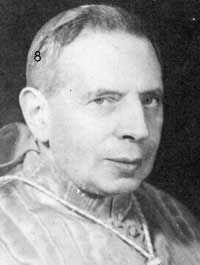
PHOTOS OF PAPAL SUCCESSION


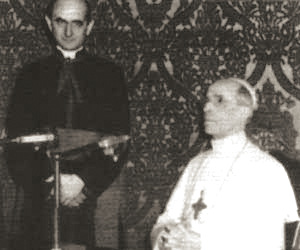
PIUS XII and MONSIGNOR MONTINI


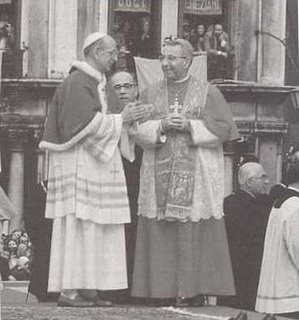
ARCHBISHOP MONTINI and CARDINAL RONCALLI


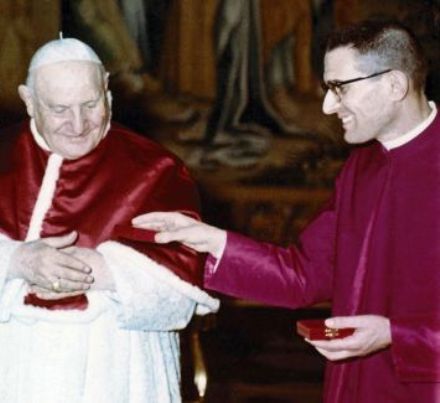
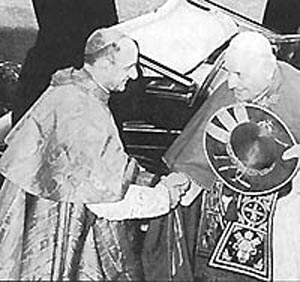
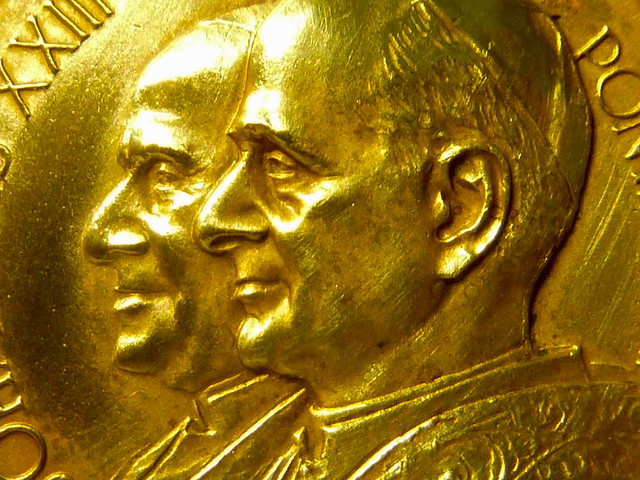
MEDAL -  JOHN XXIII and PAUL VI


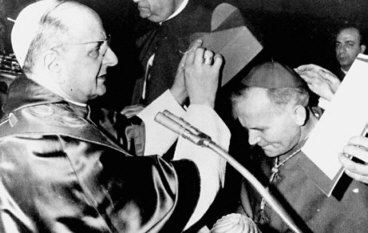
PAUL VI and NEW CARDINAL WOJTYLA


Two photos -- PAUL VI and CARDINAL LUCIANI 


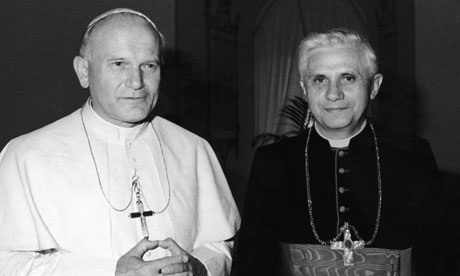
PAUL VI with ARHCBISHOP RATZINGER


 JOHN PAUL I with CARDINAL WOJTYLA


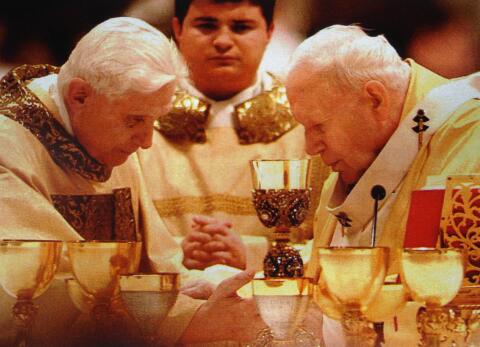
Two photos - JOHN PAUL II and CARDINAL RATZINGER

JOHN PAUL II and NEW CARDINAL BERGOGLIO

BENEDICT XVI and CARDINAL BERGOGLIO

BENEDICT XVI and FRANCIS


Thursday, May 30, 2013

June 3, 1963
Fifty Years Later --

THE LAST DAYS AND
DEATH OF BLESSED JOHN XXIII


I notice in my body the beginnings of some trouble that must be natural for an old man.  I bear it with resignation, even if it is sometimes tiresome and also makes me afraid it will get worse.  It is not pleasant to think too much about this; but once more, I feel prepared for anything.
(Journal of a Soul)


         Pope John knew -- before the Council sessions began in October 1962 -- that he suffered from the stomach cancer that ran in his family. 
 
         The four-hour ceremony of the Solemn Opening of Vatican II, which included a 37 minute address by the Pope -- Gaudet Mater Ecclesiae -- took its toll on Pope John, exhausting him.  Although he did not attend the Council's daily sessions during the autumn of 1962,  the 81-year old Pontiff followed the Council's deliberations from the papal apartment.  He was well aware of the lack of progress during the First Sessionand that, quite apparently, Vatican II would last longer than one session.  Pope John knew that he would not live to see subsequent sessions.


       On November 27, 1962, the Pope suffered a massive gastric hemorrhage.  By December 8, when he slowly processed into the Basilica to preside at the close of the First Session, the Council Fathers could see for themselves the physical effects of the Pope's sickness.  The word "cancer" was not used publicly; the official line of the Vatican was that the Pope suffered "from a cold."  It was apparent to the assembled 2,500 Bishops and to the people of Rome that Pope John was unlikely to live through the new year 1963.

        He occasionally gained strength from his resolve - a resolve no dount both spiritual as well as physical - part of his strong Bergamese constitution:

         -- During the early months of 1963, he wrote Pacem in Terris, his last encyclical. ("Peace on earth, which all men of every era have most eagerly yearned for, can be firmly established only if the order laid down by God be dutifully observed.")

         -- He began Lent, as papal tradition dictated, at the stational church of Santa Sabina in Rome.  He continued to visit parishes.

         -- He made it through the joyous but lengthy Easter ceremonies of April 14. 

         -- On May 10 and 11, Pope John received the Balzan Peace Prize.  At the end of the award ceremonies,  he appeared almost totally exhausted.  

         Pope John XXIII had less than a month to live.

- - - - - - -


         Loris Capovilla was a 37-year-old priest of of the Patriarchate of Venice when the new Cardinal Roncalli chose him to be his personal secretary.  Capovilla accompanied him to the Conclave in 1958 and stayed by his side throughout the Johannine pontificate.

     In the last days of May, 1963, it fell to Monsignor Capovilla to tell Pope John -- after a series of hemorrhages and subsequent tranfusions -- that the doctors had done all that they could.  It was too late for surgery. "The cancer has, at last, overcome your long resistance,"  Capovilla told him.

        Pope John's response:

      "Help me to die as a Bishop or Pope should..."

     On Thursday, May 30 the Pope suffered a massive hemorrhage, which left him in great pain.  Doctors administered sedatives; John slipped into unconsciousness. 

       By Friday, the 31st, there were signs of peritonitis.

     The Pope's confessor was summoned to the papal bedroom in the Apostolic Palace, as was the Papal Sacristan.  Pope John received the Blessed Sacrament as Viaticum ("food for the journey") and the anointing of the last sacrament, Extreme Unction.  He regained some consciousness.

      On Saturday, June 1, there were gathered into the dying Pope's bedchamber his several doctors; Monsignors Capovilla and Samore; Cardinal Cicognani, the secretary of state; other senior prelates of the Vatican Curia - Cardinals Tisserant, Ottaviani, Copello, Aloisi Masella, Cento and di Jorio; the Pope's valets, and the nuns of the Papal Household who had cooked and cleaned and cared for him.

     Family members -- his surviving brothers and sister -- arrived from the North and also gathered around the bed.

     And in the background was Cardinal Montini of Milan; John had personally summoned him to be present.  Montini was witness to the last days of the man who preceded him as Pope. 

      John managed to say to Monsignor Capovilla (later an archbishop and, at 97 years old, still living today):

     "When all this is over, get some rest and go see your Mother."

 - - - - - - -


      June 2 -- the last full day of Pope John's life -- was Pentecost Sunday.  A Mass was offered in the nearby study; John was fevered and in-and-out of consciousness.  At one point, he was able only to sit up a bit and talk briefly with his family, but then he began to gasp for air.  He fell into a coma. 

     A crucifix was placed in his hands - and in the early evening he mumbled a few words of the Regina Coeli, the Easter prayer he would otherwise have prayed with the crowds gathered in St. Peter's Square. 

     On the morning of Monday, June 3, he was heard to whisper two times the very words that St. Peter had addressed to the Risen Christ:
  
"Lord, you know that I love you."

Throughout the day, his breathing became more shallow, his pulse weakened.  Once again, Mass was offered in the study, this time by the Cardinal-Vicar of Rome.  At the moment Cardinal Traglia spoke the last priestly words of the Mass - "Ite missa est" ("Go, the Mass is ended") - the Pope died.

      John XXIII -- "good Pope John", the "Pope of the Council", Pastor et Nauta, "the gentle Pope", "Father to all" "Shepherd of the modern world", raised to the altar as "Blessed" -- and certainly one of the most influential Pontiffs in centuries ...

      ... had been Pope for only four years,  seven months and  six days.
- - - - - - -


From Pope John's last will and testament:

"Born poor, but of honorable and humble people, I am particularly happy to die poor, having given away, for the benefit of the poor and of the Holy Church that had nurtured me, all that came into my hands, during the years of my priesthood and episcopacy."


(Timeline from
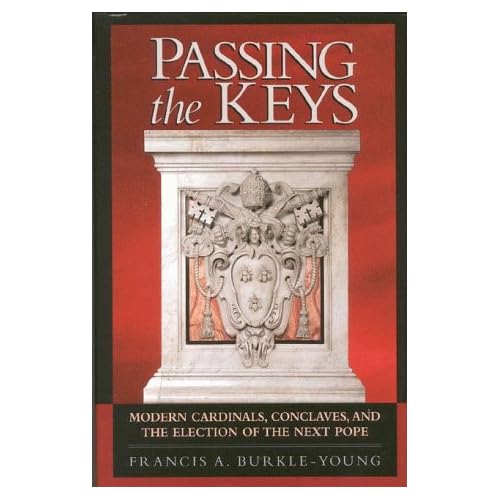
Burkle-Young's "Passing the Keys")

Saturday, March 16, 2013


Prayer for a Pope Who is “Both …”

...both Francis of Assisi and Francis Xavier:
         both reformer and missionary,
         both visionary and evangelizer...

...both Peter and Paul:
         both in the heart of the Church
         and in the court of those yet to hear and believe...

...both urbi et orbi:
         both to the See of Rome and to all the world,
         to both hemispheres - north and south... 

... both Lumen Gentium and Gaudium et Spes:
         the Vicar of Christ, Who is both
         "the light of all nations" 
         Who shares in both "our joys and our hopes",
         "our griefs and our anxieties"...

... both in continuity and in reform:
         both "father and teacher", just as the Church is
         both Mater et Magistra -
         from both Scripture and Tradition
         - the one font of Truth -
         to live both great commands:
         love of God and love of neighbor.

... both priest and prophet,
    both servant and leader,
    at both altar and table, both Priest and Victim,
         both Source and Summit -
         offering sacrifice and sacrament
         for both men and women, both young and old,
         with both saints and sinners
         worshiping in both Spirit and Truth;

         calling for conversion of both heart and mind,
         to cleanse the cup both inside and out,
         both poor in spirit and rich in mercy,
         like the wise man of the Gospel
             who brings forth from the storeroom
             graces from the One
             both ever ancient and ever new...

... with keys for both the kingdom here
         and the kingdom to come,
         both still and still moving,
         in both word and deed,
         in both speaking and listening ...

... for both health and long life...

... for both courage in Jesus
    (whose Company he keeps)
         and consolation from the Mother
               also "Miserando atque eligendo" --
               both "lowly but chosen"...

... both in the burden of the Cross now carried
    and in the hope of the Resurrection to be shared;

... blessings both now and forever.  Amen.

- Monsignor John T. Myler


Wednesday, March 13, 2013

THE CONCLAVE FIFTY YEARS AGO:

PATH FOR BERGOGLIO IN 2013
SET BY LERCARO IN 1963

(Part Five of five)

     When Giacomo Cardinal Lercaro appproached and knelt before the new Pope Paul VI at the end of the Conclave of 1963, Pope Paul -- seated on the papal throne -- had special words for Cardinal Lercaro:

"So this is how life goes, Your Eminence.  You should really be the one sitting here."

      Cardinal Lercaro and then-Cardinal Giovanni Montini had been front-runners on the earliest ballots in the 1963 conclave to replace Pope John XXIII.   Reports suggest that, eventually, the Cardinal-electors considered Cardinal Lercaro too "radical" to elect; he was famous for having turned his Cardinal's palace in Bologna into an orphanage. 

      Cardinal Lercaro, who had also received votes in the 1958 Conclave, was among the first members of the post-World War II hierarchy to preach a "Church of the poor" -- an ecclesiology that was to be developed further in Latin America, in some questionable directions -- during the 1970's.  In fact, during his tenure as Archbishop, he had tried to begin dialogue with members of the Italian Communist Party, which was the most popular political party in Bologna.

     Now, fifty years later, a Conclave of Cardinals has selected a Latin American Cardinal, Jorge Mario Bergoglio -- who lives in a humble apartment, cooks his own meals and rides the public bus system in Buenos Aires -- as the new Supreme Pastor of the Catholic Church.


     (Cardinal Lercaro and


Cardinal Bergoglio)


Just as in 1963, the Conclave fifty years later had candidates who might have been considered more cultured, more learned, more photogenic or media-savy than Francis.

And, just as it did in 1963, the 2013 Conclave could have turned to "safer" candidates.  And while the prayerful expectation is that Pope Francis will be a Pope of continuity, he has perhaps a unique opportunity for reform  - a reform no doubt strongly supported by many of his Cardinal electors.

Not since 1963, or even within the last century or more, has the call for reform been so universal.

And there is at least one more historical confluence across five decades: that -- in effect -- Benedict has said to Francis: "You should now be the one sitting" in the Chair of Peter.


Saturday, March 9, 2013


FROM THE CONCLAVE OF 1963 TO
THE CONCLAVE OF 2013:
"CONTINUITY AND REFORM"

THE ERA OF THE "FIVE POPES"
COMES TO AN END
(Part Four of five)

      Five popes at one Council -- the Second Vatican Council -- and now will come a new Pope, not a Churchman dur-ing the Conciliar years.    


     For more than fifty years -- more accurately, since the Conclave of  1958 -- the five Cardinals who have been elected Pope have all been "men of the Council":

1958: Angelo Cardinal Roncalli, in the Conclave of October 25-28, (11 ballots) became Pope John XXIII -- who surprisingly convened Vatican II.

1963: Giovanni Battista Cardinal Montini, in the Conclave of June 19-21 (6 ballots) became Pope Paul VI -- who guided the Council through the final three of its four sessions.

1978: Albino Cardinal Luciani in the Conclave of August 25-26 (4 ballots) became Pope John Paul I.  He had attended the Council as Bishop of Vottorio Veneto. His papacy would last only one month.

1978: Karol Cardinal Wojtyla in the Conclave of October 14-16 (8 ballots) became the first non-Italian Pope in over four centuries.  The Archbishop of Krakow, who had attended all the Council's sessions, took the name John Paul II.

2005: Josef Cardinal Ratzinger in the Conclave of April 18-19 (4 ballots) became Pope Benedict XVI.  He had been a peritus at Vatican II - an expert theologian who accompanied Cardinal Frings of Cologne.

 
      Now comes the Conclave of 2013 -- and the era of fifty years of Popes who were present at one Council will come to an end .

      Most probably, the Cardinal who will be elected in the next week (beginning March 12) will have been born after 1940.  He will therefore have been ordained a priest after 1965  -- after the close of the the Council.


       Who will he be?

       Fifty-nine (or just a little more than one-half) of the Cardinals in Conclave were born in 1940 or later.  They are:

Italians (12)
Bagnasco, Bertello, Betori, Calcagno, Comastri, Filoni, Piacenza, Ravasi, Scola, Sepe, Vallini, Versaldi

Germans (2)
Marx, Woelki

Spanish (1)
Canizares Llovera

French (all 4)
Barbarin, Ricard, Tauran, Vingt-Trois

Polish (2)
Nycz, Rylko

Other Europeans (7)
Bozanic (Croatia), Duka (Prague), Eijk (Utrecht), Erdo (Budapest), Kock (Switzerland), Puljic (Bosnia), Schonborn (Vienna)

Brazil (2)
Braz de Aviz, Scherer

Mexico (2)
Rivera Carrera, Robles Ortega

Argentina (1)
Sandri

Other Latin Americans (4)
Cipriani Thorne (Peru), Rodriguez Maradiaga (Honduras), Salazar Gomez (Colombia), Urose Savino (Venezuela)

United States (6)
Burke, DiNardo, Dolan, Harvey, O'Malley, Wuerl

Canada (2)
Collins, Ouellet

Nigeria (1)
Onaiyekan

Other Africans (6)
Napier (S Africa), Njue (Kenya), Pengo (Tanzania), Sarah (Guinea), Turkson (Ghana), Zubeir Wako (Sudan)

India (3)
Alencherry, Gracias, Thottunkal

Other Asians (3)
Ranjith, Rai, Tagle

Oceania (1)
Pell (Sydney)

       The name of the next Pope -- if he is 70 years old or younger -- is in the list above. 

       Considered in terms of the continents (Europeans 28 ...  Latin Americans 9 ...  North Americans 8 ...Africans 7 ... Asians and Oceania 7) it may appear that he will probably be European. 

       Considered from another angle, however, the Europeans do not dominate (Europeans 28 ... the rest of the world 31).

       Wherever he is from, whoever he is -- from the above list or from those even a bit older --  he will know the Council "second-hand".  He will not have been there -- not present in the aula of St. Peter's Basilica during the years from 1962 to 1965.

       The new Pope will have learned about the Council as history -- from studying Roncalli, Montini, Luciani, Wojtyla and Ratzinger.

       His election will, in a way, be the end of a certain linear continuity ... but it may afford the new Pope an opportunity for dynamic reform.


Thursday, March 7, 2013


 50 YEARS AGO --
THE CONCLAVE OF 1963

(Part Three of Five:  "The Ballots")


     Certainly, Cardinal Montini of Milan was the  "favorite" going into the 1963 conclave -- but his election was by no means a certainty.

     It took six ballots to elect the close collaborator of both Pius XII (Pius had "banished" him from Rome to Milan) and John XXIII (John made him the "first Cardinal" of his papacy and relied on him during the first session of the Council). 

      Although Montini was ahead in the voting from the very first ballot, he barely reached the 54 votes needed.  Cardinal Lercaro had many votes in the early balloting; his "progressive" supporters switched to Montini during the 2nd and 3rd ballots.   

(Photos from top to bottom
Giovanni Cardinal Montini,
Giacomo Cardinal Lercaro, 
Guiseppe Cardinal Siri)

    Cardinal Siri's supporters put forward Cardinal Antoniutti and, later, Cardinal Roberti, in hopes of avoiding a Montini papacy.  As their numbers slipped away, Montini edged upward - finishing with perhaps only 2 or 3 votes more than needed for election.

     Burkle-Young in Passing the Keys describes the moment:

"There was no atmosphere of elation and, surprisingly, not much sense of relief, either.  Montini had reached the throne, but just barely.  More than a fourth of the College remained completely opposed to his reign, and that quarter included a majority of those men on whom the new Pope would have to rely daily in governing the Church."

      There would be continuity -- the Council would continue.  But the accompanying reform would prove very difficult to achieve.

(Next: Continuity and Reform
in the Conclave Fifty years Later.)


Saturday, March 2, 2013


FIFTY YEARS AGO (1963 - 2013):
The Council -- Two Conclaves -- Continuity and Reform

(Part Two of five...)

To continue the Council's reforms ...?

I have returned to the U.S., to my Cathedral parish...

... allowing me to to search out this passage from the book "Passing the Keys", written by my late friend, Francis A. Burkle-Young:

In 1963, the essential question was whether (Vatican II) would be allowed to progress - to what ultimate result no one knew - or whether the new pope would limit the scope and effectiveness of the Council by shutting it down at the earliest opportunity, and then lead the Church back to something that approximated Catholicism as it had been at the death of Pius XII.  Each side saw itself as fighters for the good of the Church.

Undoubtedly, the unfinished business of the reign of John XXIII was whether or not to continue the reform which had been underway at the first session of the Second Vatican Council in the fall of 1962.

After that first session and during preparations for the second session in 1963, Pope John died from stomach cancer.  Following his death, there were three - perhaps four - obvious candidates for the Papacy:

-- Cardinal Montini, who had been close to both John and Pius XII, a curialist and recent Archbishop of Milan. He had embraced the work of the Council.

-- Cardinal Lercaro of Bologna, well-known for having converted his episcopal palace into an orphanage, and who had been a candidate in 1958.  He was certainly among the most progressive of the Council Fathers and the papal electors.

-- Cardinal Siri of Genoa, who was only 57 years old but had been a Cardinal for ten years, considered by some to be far too reactionary.  A strong candidate in four conclaves from 1958 to 1978, his main supporters were most likely curial Cardinals.

-- Cardinal Antoniutti, a well-liked Vatican diplomat who had served in places as varied as Albania, Canada and Spain. He was seen as a moderate conservative and as an alternative to Cardinal Siri. 

Continuity and reform, which would be so labeled five decades later by Pope Benedict XVI, were the dominant issues - or perhaps considered together the single most important issue - at the conclave of 1963.


Next: The ballots of 1963
JTM